
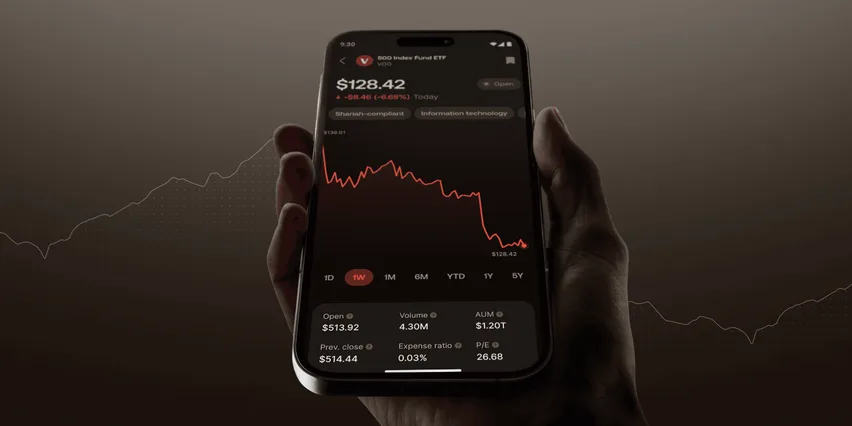
How to invest during a market downturn: a guide for UAE investors
Markets fall. It is one of the few certainties in investing. If you put money into stocks or funds and hold them for any length of time, you will sit through downturns, and some of them will be steep and frightening. The question that matters is not whether they happen. It is what you do while they are happening.
For UAE investors, investing during a market downturn brings together the universal and the local. The behavioural traps are the same ones that catch investors everywhere. The tax and currency picture, though, works in your favour in ways that change some of the practical decisions. The principles of bear market investing are the same for a UAE resident as for anyone else, but the backdrop here shifts a few of the specifics.
This guide covers both: how to think clearly when prices are dropping, and what the UAE context means for the choices in front of you.
What counts as a market downturn (and a bear market)
Not every fall is the same, and the labels matter because they shape how you should react.
Type of fall | Decline from recent peak | How common |
Pullback | Roughly 5% to 10% | Several times a year; mostly noise |
Correction | About 10% to 20% | Regular; uncomfortable but routine |
Bear market | 20% or more | Roughly once every few years; the serious one |
The distance from peak to bottom is your portfolio drawdown, and in a bear market it can run deep. A bear market is the kind of fall that makes headlines and empties the pit of your stomach, and it is the one this guide is mostly about.
There is a reassuring pattern underneath the fear. Downturns are normal and recurring, and so far the US market has recovered from every one of them and gone on to new highs. According to Hartford Funds, there have been 27 bear markets since 1928, and the average one lasted about 9.6 months, far shorter than the average bull market of roughly 2.7 years. Recovery times vary a lot, from a few months after the 2020 crash to several years after the deepest historical collapses, so nobody should promise you a quick rebound. But the long pattern has rewarded investors who stayed the course, and the S&P 500 has returned around 10% a year on average over the long run despite every crash along the way.
That history does not make a downturn painless. It does mean a downturn is a normal event to be managed, not an emergency that demands you tear up your plan.
What to do when markets fall: the first move is to not panic
The instinct when markets fall is to sell and stop the pain. That instinct is the most expensive one in investing, and behavioural finance explains why.
The evidence is stark. Research firm DALBAR has tracked what ordinary investors earn for decades, and the finding barely changes: the average equity investor underperforms the market, and the main culprit is badly timed buying and selling. In 2024, a strong year, the average equity fund investor earned about 16.5% while the S&P 500 returned around 25%, a gap of roughly 8.5 percentage points, most of it from money leaving the market at the wrong moments. That shortfall is not a one-off. It repeats, and over decades it compounds into a large amount of forgone wealth.
The driver is a well-documented quirk of human wiring. Losses feel roughly twice as painful as equivalent gains feel good, so a falling portfolio creates an urge to make the hurt stop that overpowers the logic telling you to wait. Recognising that the urge is an emotional reflex, and not a useful signal, is half the battle.
Panic selling hurts so much because the market's best days tend to sit right next to its worst ones. JPMorgan Asset Management's analysis of the past 20 years found that seven of the S&P 500's ten best days happened within about two weeks of its ten worst days. Sell to dodge the bad days and you are likely to miss the good ones sitting right beside them, and the cost of that is steep. JPMorgan's figures show what happened to a $10,000 investment over the 20 years to the end of 2024:
$10,000 in the S&P 500, 2005 to 2024 | Ending value | Annualised return |
Stayed fully invested | ~$71,750 | ~10.4% |
Missed the 10 best days | ~$32,871 | ~6.1% |
Hartford's data points the same way: about 42% of the market's strongest days in the last 20 years came during a bear market, and another 36% in the first two months of a new bull market, before it was clear the recovery had begun.
That pattern is what makes selling in a downturn so self-defeating. When you sell to feel safe, you are most likely to be out of the market exactly when the sharpest gains arrive. Staying invested is not passivity. It is the strategy the numbers support.
None of this means you can never sell. There is a difference between reacting to a falling market and responding to a real change in your own life. If your goals, your timeline, or your need for the money have changed, adjusting your plan is sound. Selling because the screen is red and the news is loud is the mistake. The test is whether the reason sits with you or with the market.
Keep investing on schedule: dollar-cost averaging
If staying invested is the defensive move, continuing to invest is the offensive one.
Dollar-cost averaging means putting a fixed amount into the market on a regular schedule, whatever the price. In normal times it is a sensible way to build a position without agonising over timing. In a downturn it quietly works in your favour, because the same fixed contribution buys more units when prices are low. Investors who kept buying through the 2008 and 2020 declines accumulated shares cheaply and did well as prices came back.
This is the disciplined version of buying the dip. The risky version is trying to guess the exact bottom and dropping a large lump sum in at what you hope is the low point. Bottoms are only visible in hindsight, and the market can keep falling for months after it already looks cheap. Continuing your regular contributions, or adding steadily rather than all at once, captures most of the benefit of lower prices without requiring you to be a fortune teller. For a salaried investor contributing every month, this needs no willpower at all: the scheduled contribution simply buys more units when the market is down, and the discipline is built into the habit.
One caveat. Dollar-cost averaging into a downturn only works if you can afford to keep going, which comes down to cash flow and a cushion, covered further below. Selling to raise cash and then trying to buy back in is the same timing mistake wearing a different hat.
Treat a downturn as a rebalancing opportunity
A sharp fall does something useful to a portfolio. It pushes the mix out of shape, which gives you a reason to act with purpose rather than fear.
Say you set out to hold 70% stocks and 30% bonds. After a steep equity decline, stocks might have slipped to 55% of your portfolio while bonds held steady. Rebalancing means selling some of what held up and buying more of what fell, to return to your target weights. Mechanically, that forces you to buy stocks when they are cheap and trim them when they are dear, the opposite of what fear tells you to do. A downturn is one of the few moments when rebalancing has a large effect.
This is where the UAE context helps in a concrete way. In many countries, rebalancing inside a taxable account triggers capital gains tax on whatever you sell, a real cost that discourages the trade. The UAE does not impose personal income tax or capital gains tax on individuals, so a resident can rebalance without a domestic tax bill eating into the benefit. That makes disciplined rebalancing cheaper and easier to do here than in most places, and it is an advantage worth using rather than leaving on the table. Caveats apply for US persons and for anyone with home-country tax obligations, which the next section covers.
Tax treatment depends on individual circumstances, the nature of the investment and any applicable foreign tax obligations. Investors should obtain independent tax advice.
Manage volatility without overreacting
Handling a downturn well is mostly about decisions you made before it arrived. Three things do most of the work:
An asset allocation that matches your real risk tolerance and time horizon. If a 20% drop would force you to sell, you were probably holding more in stocks than suited you. Volatility management starts with owning a mix you can hold through a bad year without being forced to act.
A cash buffer, kept separate from your investments. An emergency fund is what stops a downturn from becoming a disaster, because a job loss or an unexpected bill will not force you to sell shares at the worst possible time. A forced seller has no strategy; a funded investor can wait.
Managing your own attention. Checking a falling portfolio every day feeds anxiety and tempts action, so during a sharp decline, look less often and turn down the volume on market alerts. The minute-to-minute information rarely helps a long-term investor, and it reliably raises the temptation to do something you will regret.
The UAE picture: tax, currency, and access
The UAE gives residents a strong starting position for riding out downturns, with a few details to keep in mind.
The tax position is the headline. Because the UAE levies no personal income or capital gains tax on individuals, you keep the full benefit of a recovery, and you can sell or rebalance without a domestic tax charge shaping the decision. In taxed jurisdictions, tax often distorts how people behave in a downturn. Here it largely gets out of the way.
Three caveats sit underneath that:
US persons, meaning US citizens and green card holders, remain subject to US tax and reporting worldwide, so their options carry extra rules.
For non-US persons, US-domiciled holdings can still face US dividend withholding and potential US estate tax exposure on US-situs assets, regardless of the UAE's own rules, which is worth structuring around with advice.
Expats may owe tax in their home country depending on their residency status there.
None of this is tax advice, and the cross-border pieces reward a qualified professional.
On currency, UAE investors reaching into global markets typically invest in US dollars, and the Cusp platform conducts transactions in USD. During periods of market stress the dollar has often held firm or strengthened, which can cushion a dollar-based portfolio, though currency moves run both ways and should not be counted on.
When human advice earns its keep
A downturn is exactly the moment when good decisions are hardest to make alone.
Everything in this guide is simple to read and difficult to do while your portfolio is falling and the headlines are grim. The value of advice at those moments is less about picking clever investments and more about having someone steady to talk to before you make an irreversible move. A second, unemotional perspective is often what separates an investor who stays the course from one who sells at the bottom.
Cusp Wealth Ltd is regulated by the DFSA and provides wealth advisory services to investors in the DIFC, Dubai, UAE. CUSP Wealth does not manage your money for you or build a portfolio on your behalf. You build and manage your own portfolio, and CUSP's role is human advice from qualified advisors who can help you set an allocation you can live with, think through a downturn without panic, and keep the cross-border details straight. For anyone facing a falling market with real money at stake, that conversation can be worth more than any single tactic.
Bottom line
Downturns are a normal, recurring part of investing, and the US market has recovered from every one so far, even if the timing is never guaranteed. The biggest risk in a downturn is usually not the market itself but the investor's own reaction to it, which is why panic selling is so costly and staying invested pays off. Keep contributing on schedule so lower prices work for you, use the dislocation to rebalance rather than react, and make sure your allocation and cash buffer were set sensibly before the storm arrived.
For UAE residents, the absence of capital gains tax makes the disciplined moves cheaper than almost anywhere else. And when the pressure is highest, that is the time to lean on a plan, and on advice if you need it, rather than on instinct.
Disclaimer:This article is published for educational and informational purposes only. It does not constitute financial, investment, tax, or legal advice, nor is it a recommendation or endorsement of any specific financial product, fund, or service. The value of investments can go down as well as up, and you may lose all or part of your capital. Past performance is not indicative of future results. Readers should conduct their own research and consult a qualified financial adviser before making any investment decisions.
Any opinions, market commentary, research, analysis, prices, statistics, projections, or other information referred to in this article are based on information available at the time of publication. Cusp Wealth Ltd takes reasonable care to ensure that the information is accurate and obtained from sources believed to be reliable, but no representation or warranty is made as to its accuracy, completeness, reliability, or continued applicability. Any third-party information used in this article is provided for informational purposes only. Cusp Wealth Ltd shall not be liable for any losses arising directly or indirectly from reliance on, or misuse of, the information contained in this article.
Cusp Wealth Ltd is regulated by the Dubai Financial Services Authority (DFSA) and is incorporated in the Dubai International Financial Centre (DIFC). The firm holds a Category 4 licence (licence number 10863, reference number F011420) and is authorised to provide financial services to both Professional and Retail Clients, including Shariah-compliant offerings, in accordance with its DFSA licence and Islamic Endorsement.
The information in this article is current as of July 2026 and is subject to change.