Investment options in the UAE for expats: what to do with your savings in 2026
The UAE does not tax salaries, so a good income can leave real money over at the end of each month. Often it ends up in a current account, earning next to nothing while the decision about what to do with it gets pushed back again.
Five options come up again and again when expats talk about their savings: fixed deposits, gold, sukuk and bonds, property, and US stocks. Below, each one is judged on risk, liquidity, typical costs and the amount needed to start, and a table puts them side by side. No one option is the best investment in the UAE for expats, which is why three questions come first.
This article is for educational purposes only and does not constitute investment, tax or legal advice. Investing involves risk, including the possible loss of capital.
Before you choose: three questions (time horizon, risk profile, liquidity needs)
A sensible choice for one saver can leave another badly exposed, depending on how they answer the questions below.
Time horizon
If the money is meant for a flat deposit or next year's school fees, it has little time to recover from a fall. Savings that can sit untouched for ten years or more can go into assets whose prices swing. Longer horizons give prices more time to recover, though past recoveries are no guide to future ones.
Risk profile
Risk profile has two parts: how much loss your finances could absorb, and how much loss you could watch without selling. An expat with a stable income and a cash buffer can usually carry more volatility than someone supporting family abroad on a single salary. A quick test is to picture your holdings worth 25% less next month and be honest about whether you would sell.
Liquidity needs
Liquidity is how quickly an asset turns into cash without a loss. Expats face a sharper version of this question than residents who plan to stay for life, because a job change or a family event can bring a move forward by years. Some assets take months to sell. Many savers keep three to six months of expenses in an accessible account before committing money to anything less liquid.
Option 1: fixed deposits and savings accounts in the UAE
A fixed deposit locks money with a bank for a set term, commonly from one month to several years, at a rate agreed upfront. Savings accounts pay less but let you withdraw at any time. Islamic banks offer equivalents such as Wakala and Murabaha deposits, which pay an expected profit rate.
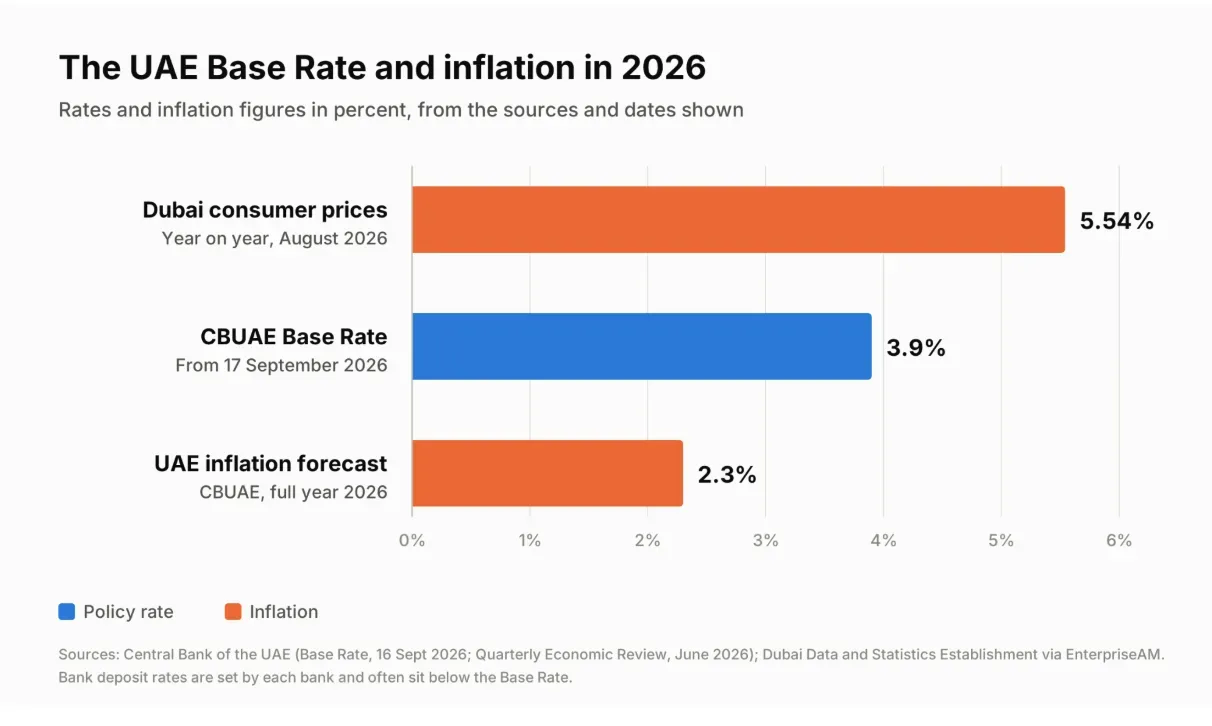
UAE rates follow the US Federal Reserve because the dirham is pegged to the dollar. On 16 September 2026 the Central Bank of the UAE raised its Base Rate by 25 basis points to 3.9%, matching a Fed increase the same day. Each bank sets its own deposit rates, which often sit below the Base Rate and vary with the amount and term.
Deposit rates are set by each bank, change with monetary policy and are fixed only for the agreed term.
The main risk with deposits is inflation. The CBUAE's Quarterly Economic Review of June 2026 forecast UAE inflation of 2.3% for 2026, while consumer prices in Dubai rose 5.54% year on year in August 2026, according to the Dubai Data and Statistics Establishment. A deposit paying less than the rate at which your own costs rise loses purchasing power, even as the balance grows.
Deposits tend to suit an emergency fund and money with a known date attached. The balance does not drop when markets do, which is the point of holding them. Breaking a fixed deposit early usually costs some or all of the interest or profit earned.
Option 2: gold, physical bars and gold-mining stocks
Gold has a long history in the Gulf as a store of value, and Dubai's gold souk makes buying bars and coins easy. It pays no income, so any return depends on the price.
The World Gold Council reports that gold rose more than 60% in US dollar terms in 2025 up to late November, setting over 50 record highs. 2026 has been rougher: gold soared to record highs in January, crossing above US$5,500/oz intraday before dipping below US$4,000/oz in late June.
Past performance is not a reliable indicator of future results. Gold prices can fall sharply and stay lower for long periods.
Physical gold
Dealers sell bars and coins at a premium above the spot price and buy them back at a spread below it. The premium is proportionally higher on a small coin than on a larger bar. Jewellery adds making charges that are rarely recovered on resale, and bigger holdings bring storage and insurance costs. AAOIFI Shariah Standard No. 57 sets out the conditions under which trading physical gold is permissible, including full payment and immediate delivery.
Gold-mining stocks
Mining shares give indirect exposure to gold. Their prices often move further than the metal in both directions, because a miner's profits rise and fall faster than the gold price. They also carry company risks that have nothing to do with gold, such as production costs, debt and the politics of the countries where the mines operate. Some pay dividends.
Option 3: sukuk and bonds
A bond is a loan to a government or company that pays interest and returns the principal at maturity.
Sukuk provide investment exposure through Shariah-compliant structures linked to underlying assets, rights or business activities. Holders receive profit distributions in accordance with the terms of the sukuk, while their ownership rights and repayment arrangements depend on the specific structure.
Sukuk vs bonds covers the differences in structure and risk in more depth.
Gulf governments and banks issue sukuk and bonds in both dirhams and dollars. Their prices are sensitive to interest rates. When rates rise, the market price of existing bonds and sukuk falls, because new issues pay more. The US and UAE rate rises in September 2026 are the kind of move that pushes existing prices down.
Holding a bond or sukuk until maturity does not guarantee repayment of the principal. Repayment depends on the terms of the instrument, the issuer's financial position and any applicable structural risks. If sold before maturity, the instrument may be worth more or less than its purchase price. Credit quality varies widely, from governments to smaller companies paying higher rates for higher risk. Individual issues often trade in large denominations, which can put direct holdings out of reach for smaller amounts.
Bond and sukuk prices fluctuate before maturity, and payments depend on the issuer's ability to pay. Profit distributions on sukuk are not guaranteed.
Option 4: UAE real estate and buy-to-let in Dubai
Ask expats about the best investment in Dubai and property is often the first answer. Foreign buyers can own freehold in designated areas, and rent gives the asset a return you can see each month.
Yield estimates differ by dataset. Global Property Guide put the average gross yield on Dubai apartments at 5.53% in its May 2026 update, based on asking rents and list prices. Engel & Völkers estimated 6.5% for Dubai residential property in August 2026, with apartments yielding more than villas. Gross yield comes before service charges, maintenance, vacancies and management fees, and Global Property Guide notes that net yields typically run 1.5 to 2 percentage points lower. Registered rents and transaction prices for specific buildings can be checked on DXB Interact.
Rental yields are market estimates, not guaranteed. Rents and property values can fall, and income stops during vacancies.
Buying and selling are expensive. The Dubai Land Department charges a 4% transfer fee on the purchase price, plus registration and trustee office fees, and agency commission commonly adds 2%. A mortgage reduces the cash needed but still requires a substantial down payment on top of fees. A sale can take weeks or months.
Then there is concentration. A single flat ties a large share of savings to one building in one city, and many expats will not stay in that city. Owning from abroad is possible, though managing tenants and repairs remotely adds cost. Islamic home finance, such as Ijara and Murabaha structures, is widely available for buyers who want a Shariah-compliant route.
Option 5: US stocks and fractional shares
A share is a small piece of a company and its future profits. Many of the world's largest companies are listed in the US. Share prices can swing hard over months or years, and investors put up with that for a stake in company growth, which may not come.
Fractional shares let you buy part of a share by dollar amount. One share of some large US companies costs hundreds of dollars, so fractions allow a modest monthly sum to be spread across several companies. Dividends are paid in proportion to the fraction held. Fractional positions can be harder to move between brokers, so a platform's transfer policy is worth checking.
Two US tax rules apply to non-US investors wherever they live. The first is dividend withholding. The US generally withholds 30% on dividends paid to non-US persons, unless a tax treaty or a specific exemption in the US tax code lowers the rate. The UAE does not appear on the IRS list of US income tax treaties, so the full rate usually applies to UAE residents.
The second is estate tax. Non-resident non-citizens may face US estate tax on US assets, including US shares, above US$60,000, subject to applicable rules and exceptions. It matters more for estate planning than for day-to-day investing, and it is easy to miss.
For Shariah-compliant exposure, stocks can be screened on business activity and financial ratios, which narrows the list of eligible companies.
The value of shares can go down as well as up, and you may get back less than you invested.
Explore fractional US shares with CUSP Wealth. CUSP Wealth is a DFSA-regulated firm in the DIFC. On its platform you build and manage your own portfolio of US shares, including fractional shares, in a USD account. Wealth advisory calls are available to clients who meet CUSP Wealth's suitability assessment. Explore the platform
For DIFC-based DFSA retail clients only. Capital at risk.
Where to invest money in the UAE: the five options compared
Costs and minimums below are typical and vary by provider.
Option | Risk | Liquidity | Typical costs | Minimum amount | Shariah option |
Fixed deposits and savings accounts | Low; inflation can erode real value | High for savings; fixed terms locked until maturity | Lost interest or profit on early withdrawal | Set by each bank | Wakala and Murabaha deposits |
Gold (physical) | Medium to high; no income | Medium; can be sold quickly at a spread | Dealer premium, buy-back spread, storage | One small coin or bar | Generally accepted with full payment and immediate delivery |
Gold-mining stocks | High; company and gold-price risk | High during market hours | Trading and currency conversion costs | One share, or a fraction where offered | Subject to screening |
Sukuk and bonds | Low to medium; depends on issuer and rates | Medium; price varies before maturity | Dealer spreads; large lot sizes | Often high for direct holdings | Sukuk |
UAE real estate | Medium; concentrated in one asset | Low; weeks to months to sell | 4% DLD transfer fee, agency fees, service charges, maintenance | Full price, or down payment plus fees | Islamic home finance |
US stocks and fractional shares | High; prices can swing widely | High during US market hours | Platform fees, currency conversion, 30% US dividend withholding | Fractional shares allow small amounts; platform minimums vary | Shariah-screened stocks |
The Shariah column describes general categories only; individual products need their own screening.
Plenty of expat portfolios hold a cash buffer alongside one or two growth or income assets, and the mix shifts as circumstances change. For setups built around regular income, see Passive income for expats in the UAE.
Small investment in Dubai: starting with a modest monthly amount
Some options are closed to small sums. Property needs a large lump sum before the first rent arrives, and direct sukuk and bond holdings often come in large denominations. With a modest monthly amount, the realistic routes are a savings account or deposit, small gold coins, and fractional shares.
Investing a fixed sum each month, often called dollar-cost averaging, spreads purchases over time. More units are bought when prices are low and fewer when they are high, which reduces the risk of putting everything in at a peak. It does not prevent losses if prices fall and stay down.
Costs weigh more on small amounts. A hypothetical fixed fee of US$2 per trade takes 2% of a US$100 purchase and 0.2% of a US$1,000 purchase. CUSP Wealth publishes its charges on its fees schedule.
Some savers build the cash buffer first and only then start a fixed monthly investment.
Why the dirham's peg to the US dollar matters for expats investing in US assets
The dirham has been pegged at 3.6725 to the US dollar since November 1997. For someone on a dirham salary, a US-dollar asset carries far less currency risk than it would for someone paid in euros or rupees, because the rate between salary and investment has stayed fixed for nearly three decades. On CUSP Wealth, accounts and transactions are in US dollars.
The peg has its limits. It is a CBUAE policy that has held since 1997, and like any policy it carries no guarantee for the future. It also imports US interest rates, which is why UAE deposit rates moved with the Fed in September 2026.
Then there is the question of where the money will be spent. Savings built in the UAE often end up in a home country or a retirement destination. If they will be spent in pounds, rupees or pesos, the currency risk that matters runs between the dollar and that currency. When the dollar strengthens against the home currency, savings converted at the end buy more there, and a weaker dollar has the opposite effect.
Red flags: unauthorised advisers and lock-in savings plans
The UAE has several legitimate financial regulators. The DFSA covers the DIFC, the FSRA covers ADGM, the CMA formerly the CMA formerly the SCA supervises securities activity onshore, and the CBUAE regulates banks and insurers. For any adviser, the test is whether they hold authorisation for the specific activity they are carrying on with you, from the regulator responsible for where they operate.
Lock-in savings plans deserve particular care. These long-term regular savings plans, often insurance-wrapped and administered offshore, are marketed to expats in the UAE. Typical features include terms that run for a decade or longer, charges weighted towards the early years, and surrender penalties that can take a large share of the money paid in if the plan is stopped early. Commission paid to the seller can be built into the structure. A plan like this can suit a saver who reads every page and stays the full term; trouble starts when the terms are not explained.
Warning signs worth stopping for:
Pressure to sign quickly, or first contact through a cold call or social media message
Returns described as guaranteed or "typical" without a source or a risk warning
Reluctance to put fees, commission and surrender charges in writing
An adviser who cannot name their regulator and reference number, or whose details do not match the register
Requests to send money to a personal account or to a company with a different name
The DFSA publishes guidance on how to avoid being scammed.
How to check a firm is DFSA-regulated
The DFSA public register is free and takes a few minutes to use.
Open the DFSA public register of firms and search for the firm's name or reference number. CUSP Wealth's reference number is F011420.
Check the firm type and status. A current authorisation appears under Authorised Firms; an entry marked Withdrawn means the authorisation no longer applies.
Read the financial services the firm is permitted to carry on, such as Advising on Financial Products or Arranging Deals in Investments, and whether it holds the endorsement to serve retail clients. Authorisation for one activity does not cover another.
Search the register of individuals for the person you are dealing with.
Compare the website, email domain and phone number with the register, and check DFSA Alerts for clone firms using a real firm's name.
Firms outside the DIFC can be checked the same way on the registers of the FSRA, SCA or CBUAE. More about CUSP Wealth as a DFSA-regulated firm is on its about page.
FAQ: investment options in the UAE
What is the best investment in the UAE for expats?
How can I invest money in the UAE with a small amount?
Is it better to invest in property or stocks in Dubai?
Do expats pay tax on investment returns in the UAE?
Can I keep my investments if I leave the UAE?
Disclaimer: This article is published for educational and informational purposes only. It does not constitute financial, investment, tax, or legal advice, nor is it a recommendation or endorsement of any specific financial product, fund, or service. The value of investments can go down as well as up, and you may lose all or part of your capital. Past performance is not indicative of future results. Readers should conduct their own research and consult a qualified financial adviser before making any investment decisions. Advisory calls are only available to clients who meet the suitability assessment required by Cusp Wealth. Not all financial products mentioned within this blog are currently products or services available on Cusp Wealth. Not all financial products mentioned within this blog are currently products or services available on Cusp Wealth.
Any opinions, market commentary, research, analysis, prices, statistics, projections, or other information referred to in this article are based on information available at the time of publication. Cusp Wealth Ltd takes reasonable care to ensure that the information is accurate and obtained from sources believed to be reliable, but no representation or warranty is made as to its accuracy, completeness, reliability, or continued applicability. Any third-party information used in this article is provided for informational purposes only. Cusp Wealth Ltd shall not be liable for any losses arising directly or indirectly from reliance on, or misuse of, the information contained in this article.
Cusp Wealth Ltd is regulated by the Dubai Financial Services Authority (DFSA) and is incorporated in the Dubai International Financial Centre (DIFC). The firm holds a Category 4 licence (licence number 10863, reference number F011420) and is authorised to provide financial services to both Professional and Retail Clients, including Shariah-compliant offerings, in accordance with its DFSA licence and Islamic Endorsement.
The information in this article is current as of October 2026 and is subject to change.