
Monthly investment plan in the UAE: how to build a SIP with fractional US shares
If you grew up in India or Pakistan, you probably know how a SIP works. A fixed amount leaves your bank account on the same date every month, goes into a fund, and you mostly forget about it.
In the UAE your salary may be higher, and there's no income tax on it, but the SIP route is harder to find. For many expats, the first mention of monthly investing comes from an adviser or a bank, and what they're offered is a long-term savings plan, often wrapped inside a life insurance policy.
That's one option. The other is to build a SIP yourself by buying fractional US shares every month. If you're trying to choose the best monthly investment plan in the UAE for your situation, two questions matter most: what will it cost you each year, and what happens if you need to stop? Below we compare both routes on those questions, then walk through how to start a SIP in the UAE yourself.
What a SIP (systematic investment plan) is
A systematic investment plan means investing a set amount at a regular interval, usually monthly, whatever the market did that month. The name comes from Indian mutual funds. In the US the same habit is called recurring or automatic investing.
You pick the amount once, say AED 1,000, and it moves on the same date every month, ideally the day after your salary lands. Because the transfer and the purchase happen automatically, you never have to log in and decide whether this is a good month to buy. Whether the plan makes or loses money depends on what it buys.
In practice, SIP investment in the UAE tends to mean one of three things. Some people keep a SIP running back home (many NRIs* do this through NRE** or NRO*** accounts). Some sign up for an insurance-linked savings plan. Others set up a recurring investment themselves on a brokerage platform. We'll focus on the last two. For more on the mechanics of recurring investing in US stocks, see our guide to SIP-style investing in US stocks.
*NRI. Non-Resident Indian. An Indian citizen (or person of Indian origin) who lives outside India. NRI status changes which bank accounts and investments they can hold in India.
**NRE. Non-Resident External account. An Indian rupee bank account funded with money earned abroad, such as a UAE salary. Interest is tax-free in India, and both principal and interest can be moved back out of India freely.
***NRO. Non-Resident Ordinary account. A rupee account for income that originates in India, such as rent, dividends or a pension. Interest is taxable in India, and moving money abroad from it is capped (up to USD 1 million per financial year, after taxes are paid).
Why SIP works: dollar-cost averaging and compounding
Dollar-cost averaging
Investing the same amount at regular intervals is called dollar-cost averaging. Your fixed amount buys more shares when prices drop and fewer when they climb, which tends to smooth out the average price you pay over time. It also means you don't have to pick the right day to buy.
Investor.gov, the US SEC's investor education site, explains dollar-cost averaging and where it falls short. Our dollar-cost averaging guide goes into more detail.
Say you put AED 1,000 a month into one company's shares for four months while the price moves around:
Month | Amount invested | Share price (AED equivalent) | Shares bought |
1 | AED 1,000 | AED 100 | 10.00 |
2 | AED 1,000 | AED 80 | 12.50 |
3 | AED 1,000 | AED 125 | 8.00 |
4 | AED 1,000 | AED 100 | 10.00 |
Total | AED 4,000 | Average price: AED 101.25 | 40.50 |
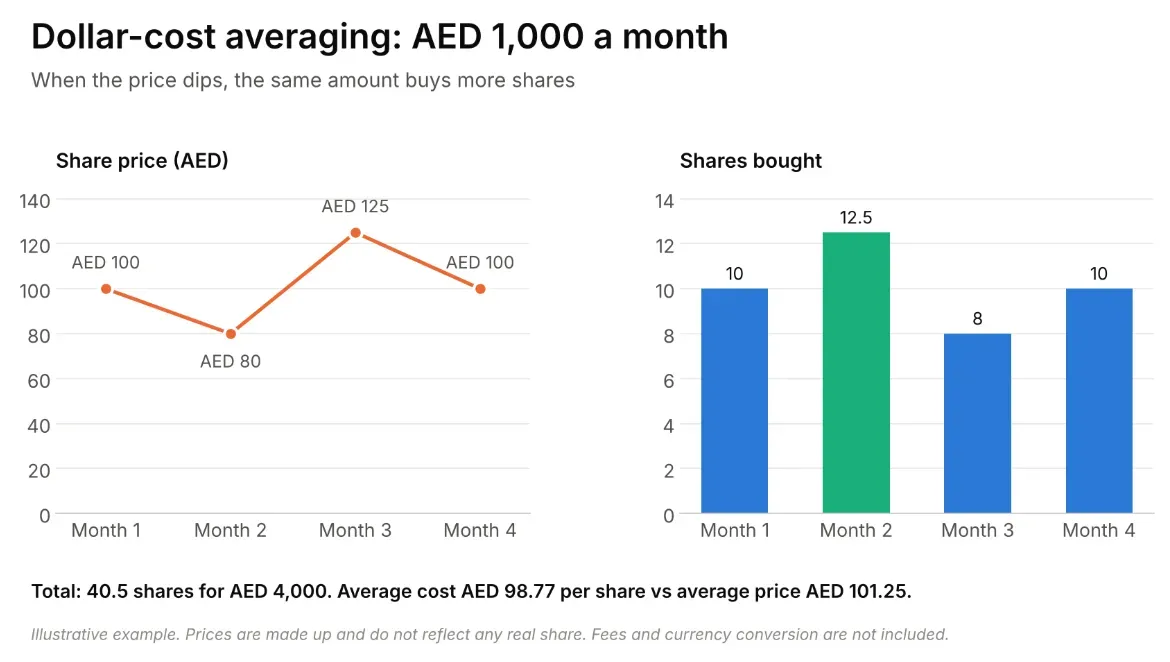
Illustrative example. Prices are made up and do not reflect any real share. Fees and currency conversion are not included.
You paid AED 4,000 for 40.5 shares, which works out at about AED 98.77 a share, while the average price over the four months was AED 101.25. The difference comes from buying 12.5 shares in month two, when the price dipped to AED 80, and only 8 in month three, when it rose to AED 125.
If prices fall and stay down, dollar-cost averaging won't stop you losing money. In a market that rises steadily, a lump sum invested earlier would usually have done better. The practical benefit is habit. Buying automatically every month is easier to start than deciding each time, and harder to abandon after a bad month.
Fractional shares make this practical on a normal salary. AED 1,000 is about USD 272 at the pegged rate of AED 3.6725 to the dollar, which won't buy one whole share in a company trading at USD 400. With fractional shares you buy about 0.68 of a share, and the whole monthly amount gets invested.
Compounding
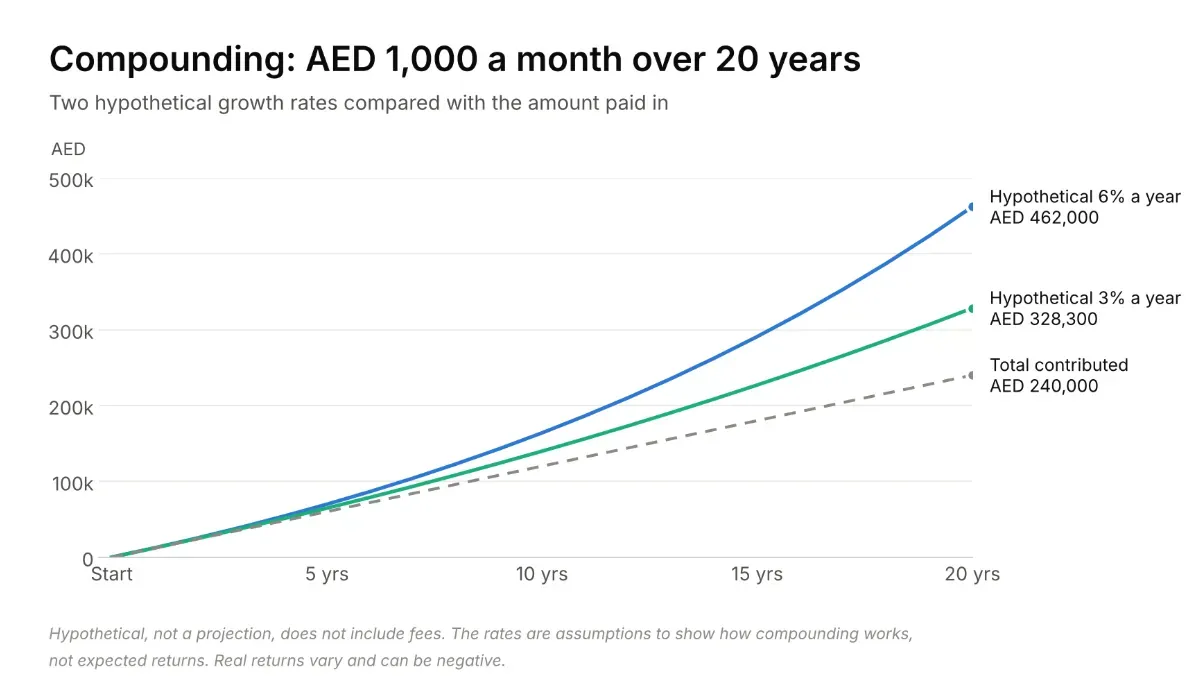
When investments grow, the growth can start earning growth of its own. Over long periods that effect does much of the work, so how long you keep going can matter more than when you start.
This table shows AED 1,000 a month over 10 and 20 years at two hypothetical growth rates:
| After 10 years | After 20 years |
Total contributed | AED 120,000 | AED 240,000 |
Hypothetical value at 3% a year | AED 139,700 | AED 328,300 |
Hypothetical value at 6% a year | AED 163,900 | AED 462,000 |
Hypothetical, not a projection, does not include fees. The 3% and 6% rates are assumptions chosen only to show how compounding works. They are not expected returns for any investment. Real returns vary from year to year and can be negative. Assumes contributions at the end of each month and monthly compounding; figures rounded to the nearest AED 100.
The gap between the two hypothetical rates is about AED 24,000 after 10 years and over AED 130,000 after 20. Fees work the same way in reverse. A yearly charge that looks small at the start is taken every year of the term, and the money it takes out is no longer there to grow.
Monthly investment plans sold in the UAE: insurance-linked savings plans explained
Many of the monthly investment plans sold through advisers and banks in the UAE are regular-premium savings plans issued by life insurance companies. You may also see them called unit-linked or investment-linked plans.
You agree to pay a fixed premium every month (or quarter, or year) for a set term, often somewhere between 5 and 25 years. Your premiums buy units in funds held inside the policy, and there may be a small amount of life cover. When the term ends, you get the value of your units.
Some people like these plans for the forced discipline, the life cover, or having an adviser pick the funds. Where buyers tend to get caught out is in not knowing what the plan costs each year, or what happens if they need to stop. Terms vary between providers, so treat what follows as a description of common features and check your own policy documents.
Lock-in period and surrender charges
Most regular-premium plans are built to be held until the end of the term. If you stop paying or cash out early, expect a surrender charge, which is a deduction from your plan's value. In the first few years, the surrender value can be well below what you've paid in.
Many plans also treat the first 12 to 24 months of premiums differently. A common approach is to put them into "initial units" that carry higher charges for the whole life of the plan, so stopping during that period, or soon after, can be expensive. Some plans let you pause or reduce premiums only after a minimum period, and that can carry charges of its own.
This matters more for expats than for people who stay put. A 15- or 25-year commitment signed in your first year in Dubai assumes a lot about where you'll live and work for the next two decades. Before you sign, ask for the surrender value in writing at years 1, 2, 3, 5 and 10, and take the documents home to read first.
The Dubai Financial Services Authority publishes consumer alerts and guidance. Read what it says about savings plans before you commit to one.
Layers of fees
Charges in insurance-linked plans are often spread across several levels, which makes the total hard to see. You might be paying:
an annual management or administration charge on the policy, sometimes with a fixed monthly fee on top
establishment charges in the early years, often a percentage of premiums or of the value of initial units
ongoing charges on the funds held inside the plan
commission to the adviser or broker, usually built into the plan's charges rather than billed to you directly
the cost of any life cover
Ask for a written illustration showing the combined effect of all these charges on your plan's value over the full term, and compare it with your other options.
SIP with fractional US shares vs insurance-linked plan
Individual plans and platforms differ, so check the terms of anything you are offered. In general, the two routes compare like this:
| DIY SIP with fractional US shares | Insurance-linked savings plan |
Flexibility | Change, pause or stop your monthly amount at any time, subject to the platform's terms | Fixed premium for a set term; changes may be restricted or charged |
Fees | Platform fees plus any trading or currency conversion costs, set out in the provider's fee schedule | Several layers: policy, establishment, fund, adviser and insurance charges |
Access to your money | Sell shares and withdraw at market value, subject to settlement times | Early surrender can trigger charges; full value is usually paid at the end of the term |
Ownership | Shares held for you by a custodian, with you as the beneficial owner | The insurer holds the underlying units; you own a policy with a contractual value |
Investment choice | You choose which US companies to buy | You choose from the plan's fund list |
Life cover | None | Often included |
Effort | You choose and review your investments | An adviser usually selects and reviews funds |
An insurance-linked plan can make sense if you want someone else to make the decisions and you're confident you won't need the money before the term ends. If you'd rather keep control and see exactly what you pay, a DIY SIP with fractional US shares is worth a look. CUSP Wealth's charges are all listed on our fees schedule.
Already in an insurance-linked plan? Don't cancel it on impulse. Get the current surrender value in writing, work out what staying costs compared with leaving, and consider independent advice before deciding.
How can you start a SIP in the UAE: step by step
Before you start, build an emergency fund that covers three to six months of expenses and clear any expensive credit card debt. Only invest money you won't need for at least five years.
Then open an account with a DFSA-regulated platform. You can check any firm on the DFSA's public register. You'll usually need your Emirates ID or passport and proof of address, and you'll answer a short questionnaire about your investing experience and goals.
Choose a monthly amount that fits your budget
Start with your monthly budget. Take your salary and subtract rent, school fees, loan repayments and whatever you send home, then put aside your short-term savings. What's left tells you roughly how much your SIP can be.
Pick an amount you could keep paying through a bad year. A modest plan you keep going is generally more useful than a big one you stop after 18 months. When your salary goes up, raise the amount. Indian investors will know this as a step-up SIP.
Pick what to buy (several US stocks across sectors vs one or two single stocks)
With a DIY plan, you decide what your monthly amount buys. Putting it all into one or two companies is simple, but if one of them runs into trouble, a large part of your plan goes with it, and your monthly contributions keep flowing into it while it struggles.
Spreading the money across companies in different sectors, such as technology, healthcare, consumer goods, financials, industrials and energy, means one company's bad news, or one industry's bad year, does less damage. With fractional shares, even a modest monthly amount can be split across several companies, each getting a fixed slice of every contribution. If picking companies isn't for you, our guide to robo-advisors in the UAE explains how automated portfolios work.
US shares are priced in dollars. While the dirham's peg to the dollar holds, AED to USD movements stay small, though conversion costs may still apply. If your long-term goal is in rupees, that exchange rate matters too.
US dividends paid to non-US investors are generally subject to US withholding tax. If you reinvest what's left, those dividends buy more shares too.
Automate it on payday
Setting it up once means you don't have to remember every month:
Set up a standing order from your UAE bank account to your investment account for the day after your salary usually arrives.
Schedule a recurring investment on the platform for a day or two later, using the split across companies you chose.
Review the plan once or twice a year. Make sure your mix of companies and sectors still looks the way you meant it to, and adjust the monthly amount if your income has changed.
How much to invest each month: examples for AED 500, 1,000 and 3,000
The right amount depends on your budget. This table shows what you would put in at three common monthly amounts, before any growth or losses.
Monthly amount | Approx. USD | Contributed after 1 year | After 5 years | After 10 years |
AED 500 | USD 136 | AED 6,000 | AED 30,000 | AED 60,000 |
AED 1,000 | USD 272 | AED 12,000 | AED 60,000 | AED 120,000 |
AED 3,000 | USD 817 | AED 36,000 | AED 180,000 | AED 360,000 |
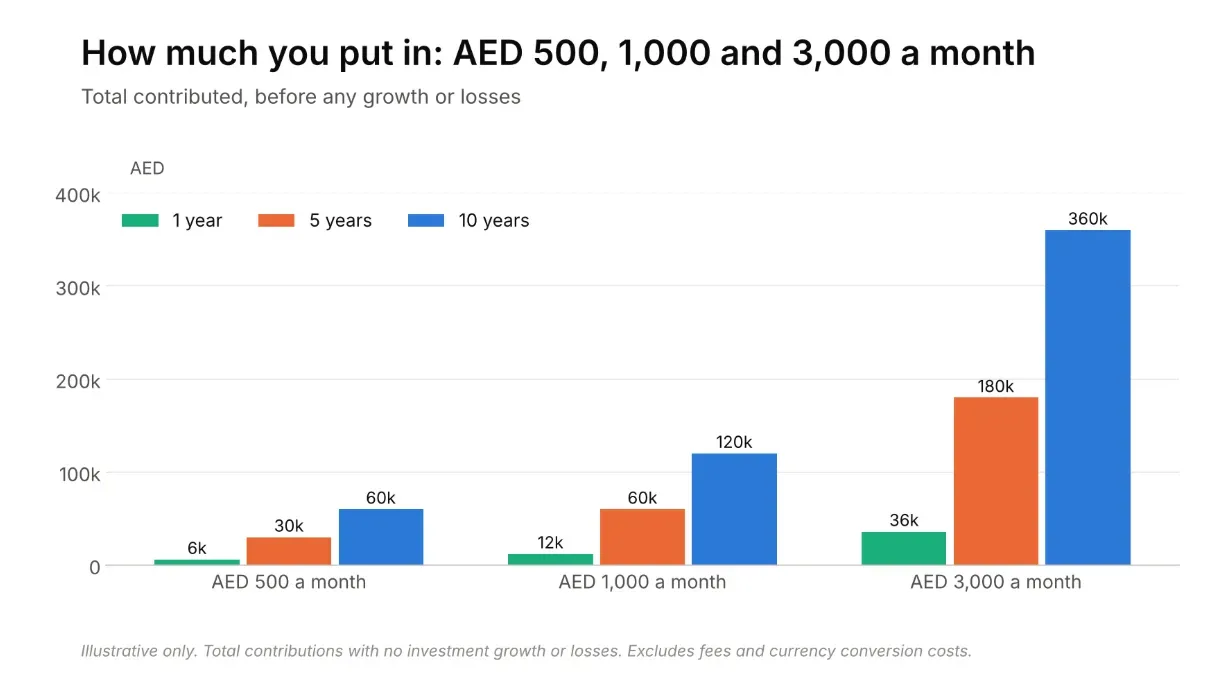
Illustrative only. Figures show total contributions, with no investment growth or losses, and do not include fees or currency conversion costs. USD figures use the pegged rate of AED 3.6725.
With fractional shares, AED 500 a month can still be spread across three or four companies. AED 1,000 can cover five or six in different sectors, and AED 3,000 can stretch to eight or ten.
Common mistakes
The big one is stopping when markets fall. Pausing feels sensible at the time, yet falling prices are when your fixed amount buys the most shares. If you stop then, you miss the months when dollar-cost averaging does the most for you.
Another is putting too much in one place. If your plan is mostly one or two companies, one sector or your own employer's shares, a single piece of bad news can hit all of it.
A few others to watch for:
investing money you'll need within a few years, such as a home deposit, school fees or the cost of leaving the UAE
not knowing what you pay in fees, which matters most when there are several layers of charges
signing a multi-year plan without first reading the lock-in period and surrender terms
FAQ
What is the best monthly investment plan in the UAE?
How do I start a SIP in the UAE?
Can I cancel a monthly savings plan in the UAE?
Is SIP better than a lump sum?
How much should I invest each month?
Disclaimer: This article is published for educational and informational purposes only. It does not constitute financial, investment, tax or legal advice, and it is not a recommendation or endorsement of any particular financial product, fund or service. The value of investments can go down as well as up, and you may lose some or all of your capital. Past performance is not an indicator of future results. Readers should do their own research and consult a qualified financial adviser before making any investment decisions. Advisory calls are only available to clients who meet the suitability assessment required by Cusp Wealth. Not all financial products mentioned in this blog are products or services currently available from Cusp Wealth.
Any opinions, market commentary, research, analysis, prices, statistics, forecasts or other information referred to in this article are based on information available at the time of publication. Cusp Wealth Ltd takes reasonable care to ensure the information is accurate and drawn from sources believed to be reliable, but makes no representation or warranty as to its accuracy, completeness, reliability or continued applicability. Any third-party information used in this article is provided for information only. Cusp Wealth Ltd accepts no liability for any losses arising directly or indirectly from reliance on, or misuse of, the information in this article.
Cusp Wealth Ltd is regulated by the Dubai Financial Services Authority (DFSA) and is incorporated in the Dubai International Financial Centre (DIFC). The firm holds a Category 4 licence (licence number 10863, reference number F011420) and is authorised to provide financial services to Retail Clients, including Shariah-compliant offerings, in accordance with its DFSA licence and Islamic Endorsement.
The information in this article is current as of October 2026 and is subject to change.