How to build wealth from scratch by investing in the US market from the UAE
A salary in Dubai can leave room to save, and the UAE does not levy income tax on individuals. Turning that surplus into wealth usually takes decades of steady monthly investing, and most of the growth comes late, once returns on the balance start to outpace new contributions.
How to become rich in Dubai on a salary
Wealth built on a salary rests mostly on two inputs: how much of each pay cheque gets invested, and how long it stays invested. Returns matter too, though nobody can set them in advance.
In the illustration below, $500 a month for 20 years at a constant 7% grows to about $260,000. Kept up for 30 years, the same $500 a month reaches about $610,000. The extra ten years add $60,000 in contributions and roughly $350,000 in value.
For a salaried investor, becoming rich in Dubai is usually a slow build: a portfolio that may, over two or three decades, grow large enough to widen the choices around work and retirement. Shortcuts such as concentrated bets on a single stock or trading with borrowed money raise the risk of large losses along with the chance of quick gains.
How to build wealth from scratch: cash reserves and debt
A cash reserve covering a few months of essential expenses means an emergency doesn't force a sale of shares at a bad moment. If a job ends or a large bill arrives during a market fall, the reserve pays for it and the shares can stay invested.
Paying off a high-interest credit card balance saves interest at the card's rate with certainty, which no investment can promise. Where that rate is high, clearing the balance first may leave more money to invest later.
Neither step has to be complete before a first investment. Some investors put a small monthly amount into shares while the reserve builds, which gets the habit started early.
Setting a monthly amount
A fixed percentage of salary is easier to keep up than an amount decided month by month. Some investors start with a share small enough to barely notice and raise it once the habit holds. A few months of tracked spending show what level is realistic.
Investing for beginners in the UAE: starting with small amounts
A small starting balance is less of a barrier than it used to be. Many brokers now offer fractional shares, which let an investor buy part of a share for a set dollar amount. The SEC's investor bulletin on fractional shares explains that firms differ in which stocks they offer this way, and some charge fees on fractional trades, so the terms are worth checking before the first order.
Starting small also makes early mistakes cheaper. Selling in a panic during a market fall, or buying a stock because it was trending that week, costs far less on a $1,000 balance than on $100,000. The first year or two can work as practice with real money at stake.
A beginner's portfolio can stay simple. A spread of large, established US companies in different sectors, or a broad fund that holds hundreds of them, carries less single-company risk than one or two favourite names.
Compounding and the cost of starting late
Compounding happens when investment growth is added to the balance and then grows along with it. In the early years the effect is small enough to miss. Later, growth on the existing balance can add more each year than the contributions themselves.
The table follows $500 invested every month at two illustrative annual rates.
Years invested | Total paid in | Value at 5% a year | Value at 7% a year |
10 | $60,000 | $77,641 | $86,542 |
20 | $120,000 | $205,517 | $260,463 |
30 | $180,000 | $416,129 | $609,985 |
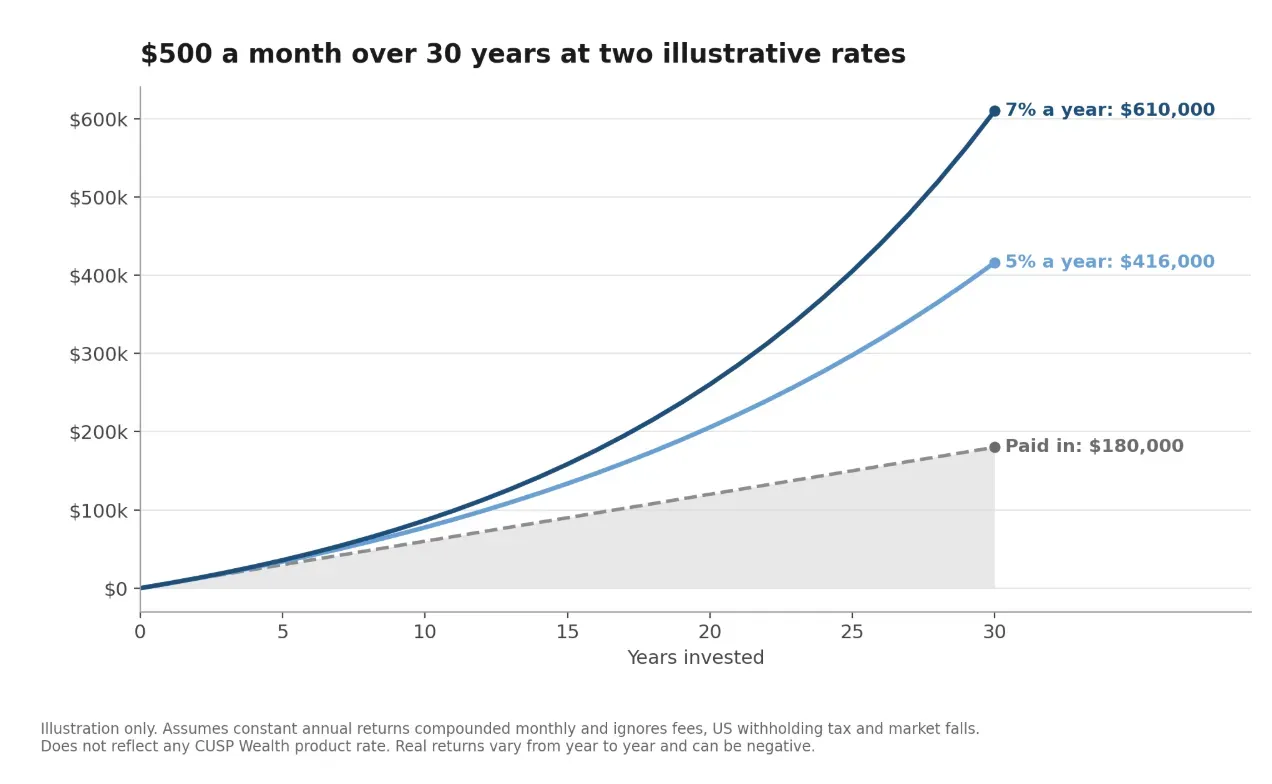
Starting ten years later is expensive. Someone who begins at 35 and invests $500 a month until 55 reaches about $260,000 at 7%. Doubling the amount to $1,000 a month over the same 20 years reaches about $521,000, still short of the $610,000 that $500 a month builds over 30 years.
This is an illustration only. It assumes constant annual returns of 5% and 7% compounded monthly, ignores fees, US withholding tax and market falls, and does not reflect any CUSP Wealth product rate. The figures are presented in nominal US dollars and do not account for inflation or changes in purchasing power. Real returns vary from year to year and can be negative.
Consistent investing versus trying to time the market
Investing a fixed amount every month takes the timing question off the table. The same sum buys more shares when prices are low and fewer when they are high, an approach known as dollar-cost averaging. It does not guarantee a profit or prevent losses in a falling market, though it removes the need to guess the right moment.
Morningstar's Mind the Gap 2026 study puts a figure on what poor timing costs. Over the ten years to the end of 2025, the average dollar invested in US mutual funds and ETFs earned 8.7% a year, while the funds themselves returned 9.9% a year. Morningstar attributes the 1.2 percentage point gap to the timing and size of investors' purchases and sales, and estimates it at around 12% of the funds' total return.
A fixed transfer each payday removes most of those decisions.
Raising contributions as income grows
Living costs can rise with salary, and a fixed monthly amount shrinks as a share of income over time. Linking contributions to pay rises keeps them in proportion.
In an extended version of the earlier illustration, $500 a month that rises by 5% each year reaches about $2,058 a month by year 30. At a constant 7%, that portfolio grows to about $1,055,000, against about $610,000 for a flat $500 a month. The investor pays in roughly $399,000 over the period, compared with $180,000 on the flat plan.
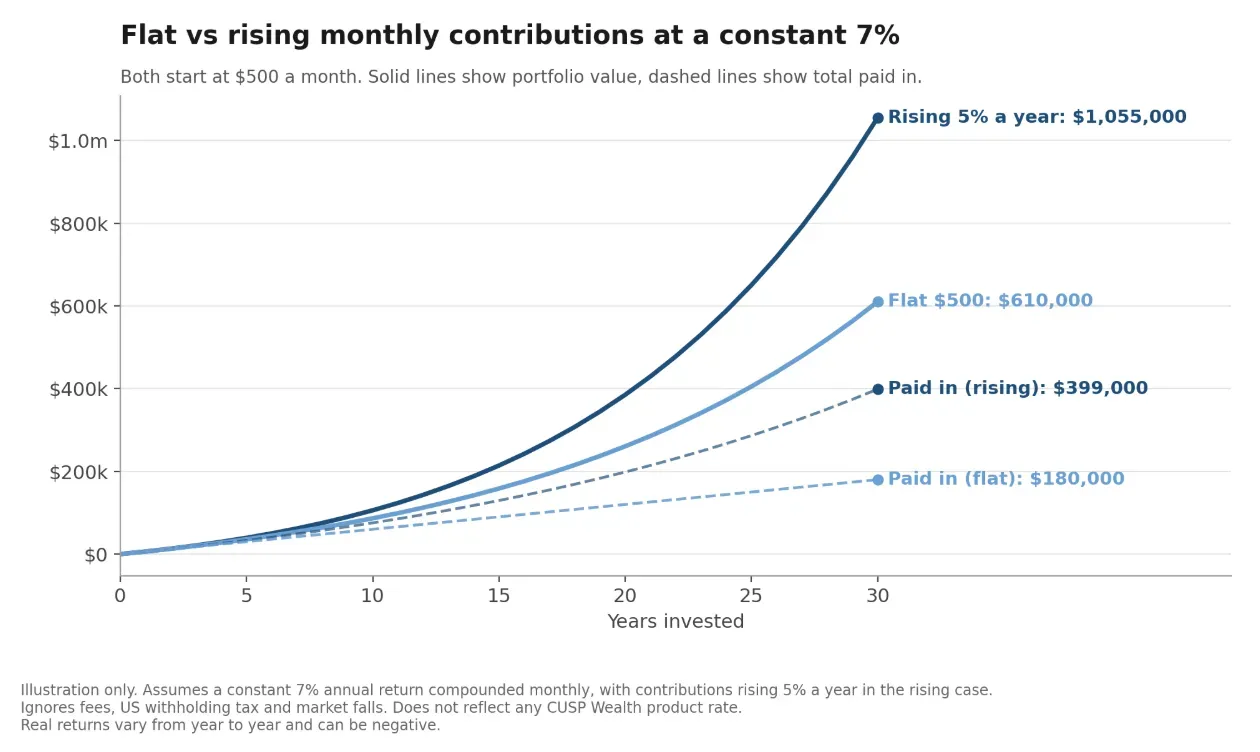
Illustration only. It assumes a constant 7% annual return compounded monthly and contributions rising 5% a year, ignores fees, taxes and market falls, and does not reflect any CUSP Wealth product rate.
Spreading a growing portfolio across US companies
Hendrik Bessembinder of Arizona State University has updated his research to cover 29,754 US stocks from 1926 to 2025. Just 1,082 companies, about 3.7% of the total, accounted for all of the net wealth the US market created above Treasury bill returns over that century, and 59% of companies destroyed wealth relative to Treasury bills.
A portfolio of five or six names can easily miss those few large winners. A wider spread across companies of different sizes and sectors raises the chance of owning some of them, and limits the damage any one company can do.
Investors build that spread in different ways. Some hold a larger number of individual US stocks across sectors. Others use broad index funds or ETFs, where one purchase covers hundreds of companies. Both routes still carry market risk, since diversification reduces single-company risk and offers little protection when the whole market falls.
Financial discipline and a long-term mindset when markets fall
Losing years are a normal part of owning shares. From 1926 through 2022, the S&P 500 posted a loss in 26 of 97 calendar years on a total return basis, roughly one year in four, according to First Trust, citing Ibbotson Associates and Morningstar data. The three full years since, 2023 to 2025, all ended positive.
Some of those falls are steep. Including dividends, the S&P 500 lost 37.00% in 2008 and 18.11% in 2022, according to Slickcharts' S&P 500 total return data. The same data shows a 26.46% return in 2009, the year after the 2008 fall. Past recoveries say nothing certain about future ones, and some have taken years.
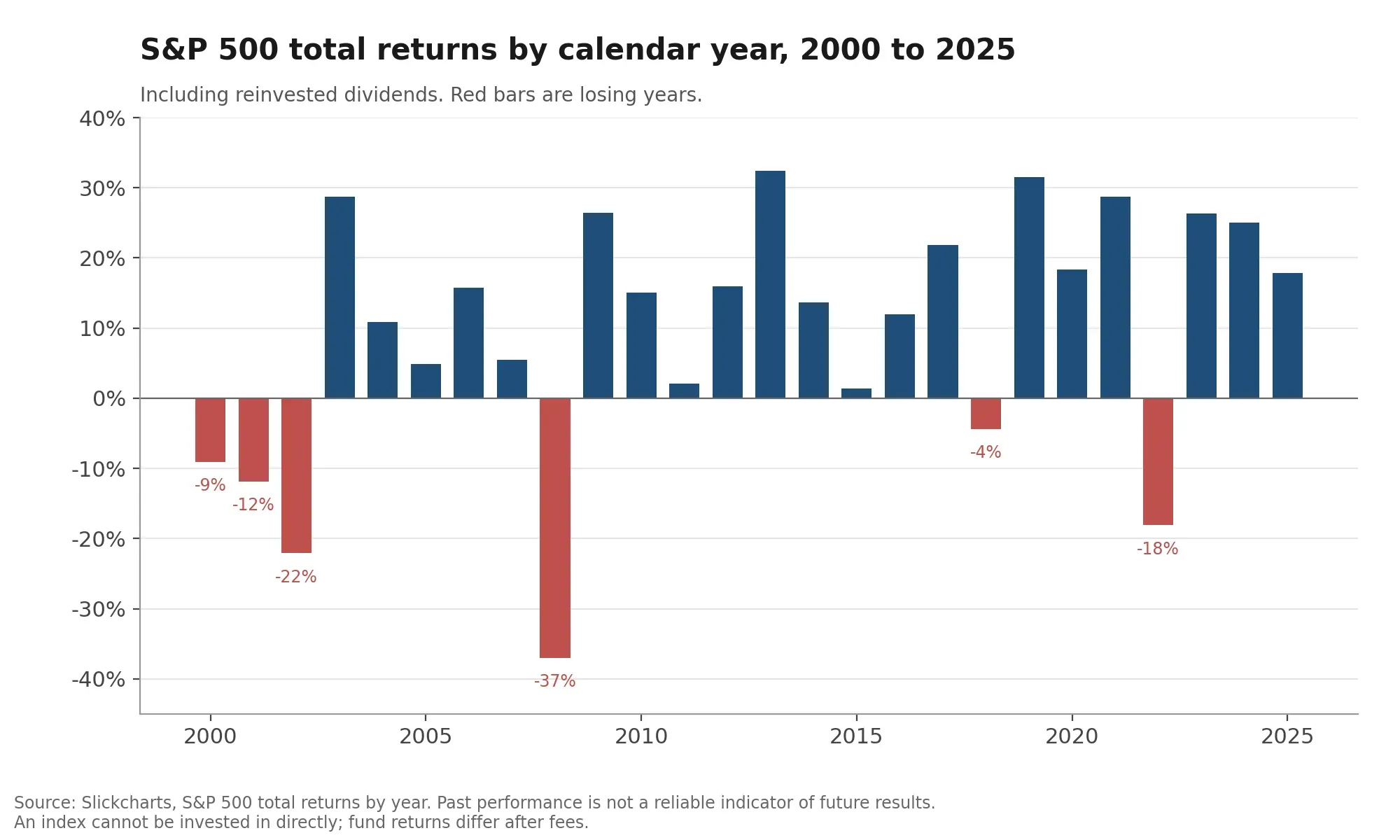
The pull during a fall is to sell and wait for calm. Selling turns a paper loss into a real one, and a rebound can start before the news improves, which makes the moment to buy back hard to judge. Writing down the reason for investing and the expected timeframe, before the next fall arrives, gives something to check against when prices drop.
US tax points for UAE residents investing in US stocks
The UAE does not tax individuals on income, though US rules still apply to US shares. Dividends from US companies paid to a nonresident are withheld at 30%, or at a lower treaty rate where one applies, and the UAE does not appear on the IRS list of countries with an income tax treaty in force with the US. For a UAE tax resident holding US shares directly, the standard 30% generally applies to dividends, unless an exemption or reduced rate applies, unless an exemption or reduced rate applies.
According to the same IRS guidance, capital gains are usually not taxable for a nonresident alien present in the US for fewer than 183 days in a calendar year.
As the balance grows, US estate tax becomes relevant. The IRS states that the estate of a nonresident who is not a US citizen must file a US estate tax return if US-situated assets, including stock in US corporations, are worth more than $60,000 at death. The structure of larger holdings is worth reviewing with a qualified tax adviser.
US citizens and resident aliens, a group that includes green card holders, remain subject to US tax on their worldwide income while living in the UAE. Obligations in a home country may also apply.
Checking DFSA regulation before opening an account
The DFSA regulates financial services carried on in or from the DIFC. According to the DFSA, its public register lists every Authorised Firm along with the financial services each one is licensed to provide.
A DIFC address on its own says little. The DFSA has stated that a company incorporated or licensed in the DIFC may not carry on financial services business there unless the DFSA has authorised it.
Firms elsewhere in the UAE answer to other regulators, such as the Financial Services Regulatory Authority in Abu Dhabi Global Market, and the DFSA notes that those regulators keep public registers of their own.
Starting to invest in US stocks with CUSP Wealth
CUSP Wealth is a DFSA-regulated firm based in the DIFC. Through its platform, investors build and manage their own portfolios of US stocks, with accounts held in US dollars. CUSP Wealth also provides wealth advisory services.
It's possible to invest with $50, which makes a small monthly start practical. The choice of holdings, and how much to add each month, stays with the investor.
Cusp Wealth Ltd is regulated by the DFSA.
Frequently asked questions about building wealth from the UAE
How to become rich in Dubai by investing?
How much money is needed to start investing in the UAE?
What should beginners in the UAE know before investing in US stocks?
How long does it take to build wealth by investing?
Are investments protected if a US broker fails?
Disclaimer: This article is published for educational and informational purposes only. It does not constitute financial, investment, tax, or legal advice, nor is it a recommendation or endorsement of any specific financial product, fund, or service. The value of investments can go down as well as up, and you may lose all or part of your capital. Past performance is not indicative of future results. Readers should conduct their own research and consult a qualified financial adviser before making any investment decisions. Advisory calls are only available to clients who meet the suitability assessment required by Cusp Wealth. Not all financial products mentioned within this blog are currently products or services available on Cusp Wealth. Not all financial products mentioned within this blog are currently products or services available on Cusp Wealth.
Any opinions, market commentary, research, analysis, prices, statistics, projections, or other information referred to in this article are based on information available at the time of publication. Cusp Wealth Ltd takes reasonable care to ensure that the information is accurate and obtained from sources believed to be reliable, but no representation or warranty is made as to its accuracy, completeness, reliability, or continued applicability. Any third-party information used in this article is provided for informational purposes only. Cusp Wealth Ltd shall not be liable for any losses arising directly or indirectly from reliance on, or misuse of, the information contained in this article.
Cusp Wealth Ltd is regulated by the Dubai Financial Services Authority (DFSA) and is incorporated in the Dubai International Financial Centre (DIFC). The firm holds a Category 4 licence (licence number 10863, reference number F011420) and is authorised to provide financial services to both Professional and Retail Clients, including Shariah-compliant offerings, in accordance with its DFSA licence and Islamic Endorsement.
The information in this article is current as of October 2026 and is subject to change.