
How to invest in stocks: a beginner's guide for UAE residents
Buying your first share can feel like a big step, especially if nobody around you talks about investing. Most of the real work happens before you buy anything, when you decide why you are investing and how long you can leave the money alone.
This guide takes you from what a stock is to your first order and beyond. It is written for UAE residents, so it covers Emirates ID checks, the W-8BEN form for US shares and moving money from dirhams into dollars.
What are stocks?
A stock, also called a share or an equity, gives you a share of ownership in a company (Investor.gov, SEC). Buy one share and you own a small piece of that business, alongside every other shareholder.
Companies sell shares to raise money to grow. Once a company is listed on a stock exchange, such as the New York Stock Exchange (NYSE) or Nasdaq, investors buy and sell its shares with each other on every trading day. The share price is what one share costs at a given moment. It moves with supply and demand, which reflect what investors expect from the company's future profits.
How you can earn from stocks
A stock can make money for you in two ways.
Price growth. If the share price rises above what you paid, you can sell for a profit, known as a capital gain. Until you sell, the gain exists only on paper.
Dividends. Some companies pay part of their profits to shareholders, often every quarter. Many younger, fast-growing companies pay nothing and put their profits back into the business.
Both can also work against you. Prices move down as well as up, and a company can cut or stop its dividend at any time. If a company fails, shareholders are the last in line to be paid (Investor.gov).
Say you buy one share for $100. Over a year it pays $2 in dividends and the price ends the year at $108. Your return before fees and taxes is $10, or 10%. If the price had ended at $90 instead, you would be down $8, even after the dividend (hypothetical example).
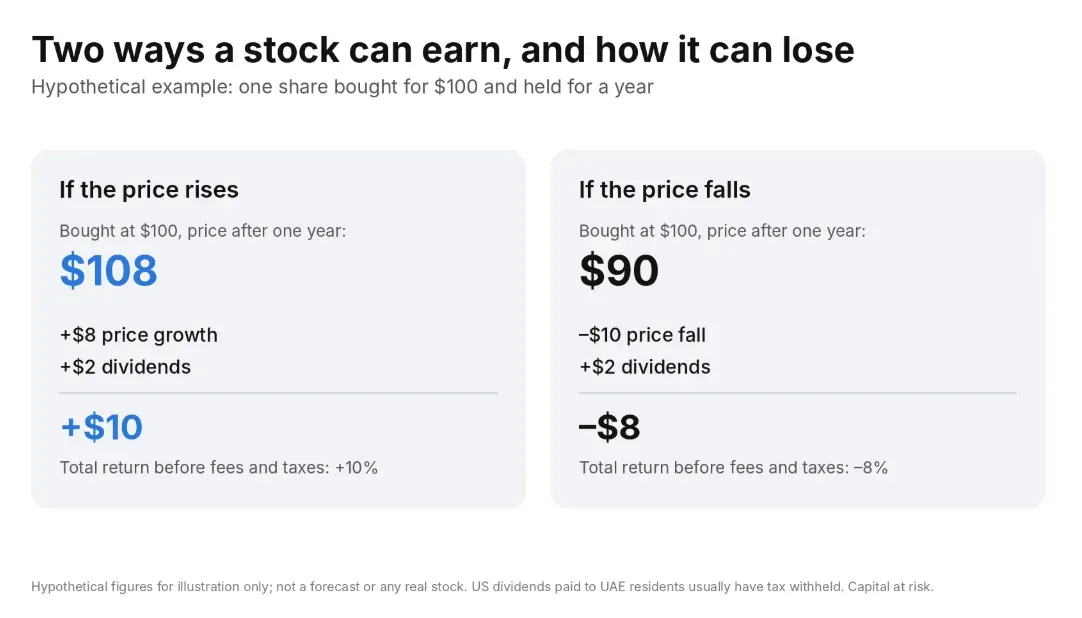
Hypothetical figures for illustration only; not a forecast or any real stock. Source: CUSP Wealth, based on the return types described by Investor.gov (SEC). Capital at risk.
Stocks vs other investments
Many people in the UAE already hold savings in a bank deposit, gold or property. Stocks behave differently from each of them, and many investors end up holding a mix.
Investment | How it can earn | What to weigh up |
Bank deposits | Interest | Low risk to the amount you deposit, but returns may not keep up with rising prices over time |
Gold | Price changes only | Pays no income, and the price can fall or stay flat for long periods |
Property | Rent and price changes | Needs a large sum, carries buying and running costs, and can take months to sell |
Stocks | Price growth and dividends | Prices can swing sharply in the short term; you can start with small amounts and sell on any trading day |
The SEC's investor education site describes stocks as offering "the greatest potential for growth" over the long haul, and notes that investors who held stocks for long periods have generally been rewarded. It also points out that large company stocks as a group have lost money in about one year out of every three (Investor.gov). Past performance is not a reliable indicator of future results.
Before you start: emergency fund, goal, time horizon, risk tolerance
Four questions are worth answering before you open any account. Your answers shape how much you invest and what you buy.
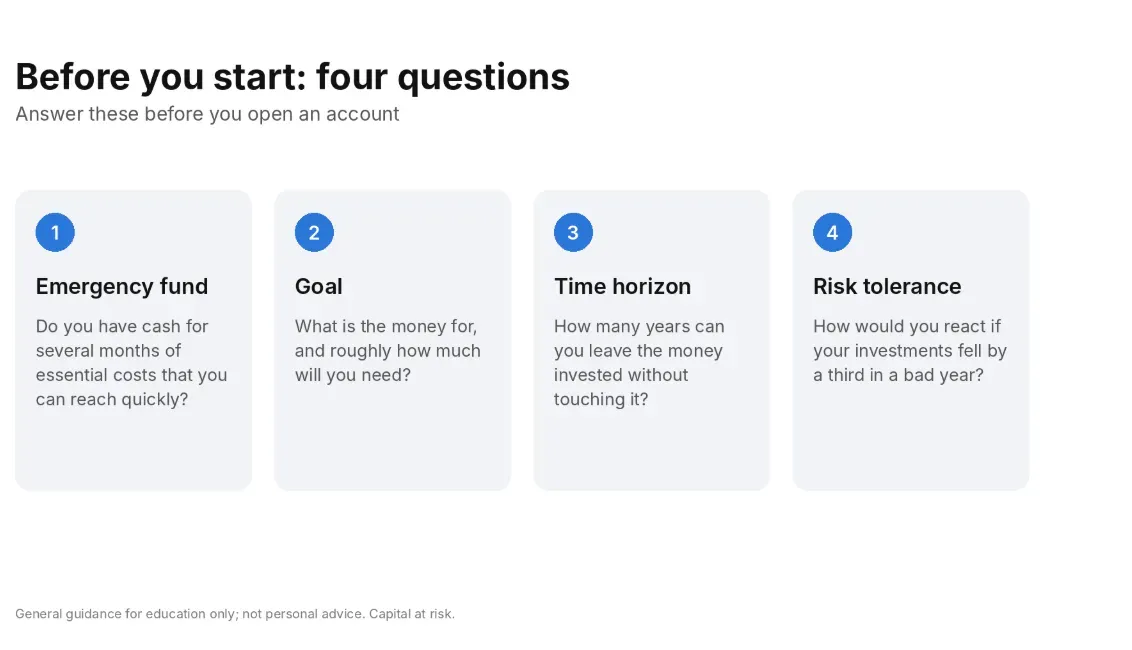
General guidance for education only; not personal advice. Source: CUSP Wealth. Capital at risk.
Do you have an emergency fund?
Keep enough cash to cover several months of essential costs in an account you can reach quickly. Many people aim for three to six months. With that cushion in place, a job change or an unexpected bill will not force you to sell shares at a bad moment.
What is the money for?
A goal gives your investing a purpose and helps you decide how much to put in each month. A home deposit in five years, a child's education in twelve and retirement in thirty each call for different choices.
How long can you leave it invested?
Your time horizon is how long the money can stay invested without you needing it. Stocks can fall sharply in a single year, so money you need within the next few years is usually better kept somewhere steadier. A longer horizon gives your investments more time to recover from falls, though a recovery is never certain.
How much risk can you live with?
Risk tolerance is how far your investments can fall before it affects your sleep or your plans. Picture your portfolio losing a third of its value in a bad year. If that would make you sell everything, start with a smaller amount and build up as you get used to how markets move.
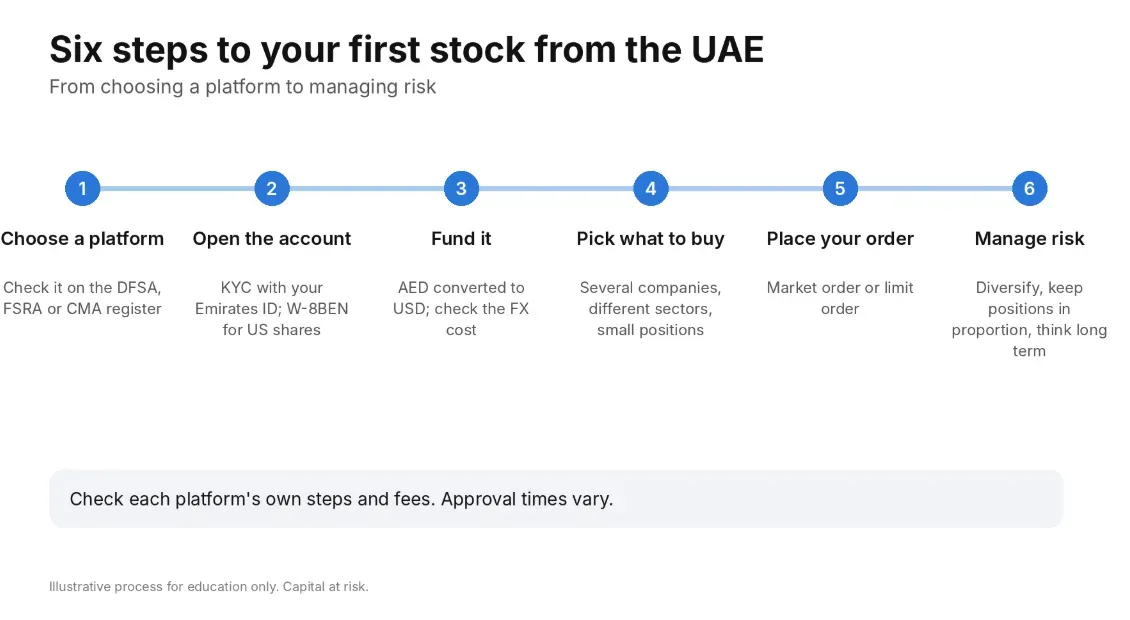
With those answers in mind, the process itself comes down to six steps.
Illustrative process for education only; steps and approval times vary by platform. Source: CUSP Wealth. Capital at risk.
Step 1: Choose a regulated platform
To buy shares you need a brokerage account. This is an account with a licensed firm that buys and sells shares on your behalf and holds them for you. In the UAE, investment firms are licensed by one of three regulators, depending on where they are based:
the Dubai Financial Services Authority (DFSA), for firms in the Dubai International Financial Centre (DIFC)
the Financial Services Regulatory Authority (FSRA), for firms in Abu Dhabi Global Market (ADGM)
the Capital Market Authority (CMA), formerly the Securities and Commodities Authority (SCA), for firms licensed onshore
Before you sign up, look the firm up on its regulator's public register. Check the company name, the licence number and the activities it is allowed to carry out. The DFSA public register is free to search.
Then compare the platforms that pass the check: the markets on offer, fractional shares, and the fees for trading, holding shares and converting currency.
Step 2: Open the account: KYC, Emirates ID, W-8BEN
Every regulated platform has to confirm who you are before you can invest. These checks are called know your customer (KYC), and on most platforms they take place in the app. Expect to provide:
your Emirates ID, and often your passport
a selfie or short video, so the app can match your face to your ID
proof of address, such as a utility bill or tenancy contract
details of your job, income and where your money comes from
answers about your investing experience, goals and finances
The last set of questions is the suitability check. Answer it honestly, because it decides which products the platform can offer you. On CUSP, identity checks, the W-8BEN and funding are handled in one digital onboarding flow.
The W-8BEN form for US shares
If you plan to buy US shares, you will also sign a W-8BEN. This US tax form confirms you are not a US person for tax purposes. A signed form generally stays valid until the end of the third calendar year after the year you sign it (IRS instructions for Form W-8BEN).
The US has no income tax treaty with the UAE, so US dividends paid to UAE residents generally have 30% tax withheld before they reach you. For questions about your own situation, speak to a tax advisor.
Approval can take anything from a few minutes to a few days, depending on the platform and whether it needs extra documents.
Step 3: Fund your account (AED to USD)
US shares are priced and traded in US dollars. If you are paid in dirhams, your money needs converting at some point, either by your bank before you send it or by the platform when it arrives.
The dirham is pegged to the dollar at AED 3.6725 (Central Bank of the UAE), so the rate itself barely moves. What differs between providers is the cost of converting. Banks and platforms may charge a fee or add a margin to the rate, so compare how many dollars actually arrive in your account.
For example, AED 3,672.50 converts to $1,000 at the pegged rate. A 0.5% conversion cost would leave you with $995 (illustrative example).
CUSP accounts are held in US dollars.
Only add money you can leave invested for several years. Capital at risk. The value of investments can fall as well as rise, and you may get back less than you invest.
Step 4: Choose what to buy: how many stocks, which sectors, position size
This is where many beginners get stuck. Three questions help: how many companies to own, which sectors they come from and how much to put into each one.
How many stocks to own
If you own one company, your result depends entirely on how that company does. Owning several spreads the risk, so a bad year for one business has a smaller effect on the whole. There is no perfect number, and your portfolio can grow company by company as you add money.
Fractional shares help here. A fractional share is part of a share, so you can invest a set dollar amount instead of paying for whole shares. If a company's shares cost $400, $50 buys you 0.125 of a share (illustrative example). Our guide to fractional shares in the UAE explains how they work.
Which sectors
The US market is grouped into 11 sectors, from information technology and healthcare to energy and consumer staples, the companies behind everyday goods such as food and household products. Companies in the same sector often rise and fall together, so owning companies from several sectors spreads your risk further.
How to research a company
Find out what the company sells, how it makes money, whether it is profitable and how much debt it carries. US-listed companies publish annual and quarterly reports (Forms 10-K and 10-Q), free to read on the SEC's EDGAR database. If you could not explain the business to a friend in two sentences, keep reading before you buy.
Position size
Position size is how much of your portfolio sits in a single company. A common rule of thumb is to keep any one stock to a small share of your total, often no more than 5% to 10%, once your portfolio has grown. That way a sharp fall in one company does not derail your plans.
With only a few companies at the start, each one will be a bigger slice. Say you put $200 into each of five companies in five sectors (hypothetical example). If one falls by 30%, your $1,000 portfolio falls by $60, or 6%. With all $1,000 in that company, you would be down $300.
This guide is for education and does not recommend any particular stock. Capital at risk. The value of investments can fall as well as rise, and you may get back less than you invest.
Step 5: Place your first order: market order vs limit order
Search for the company in the app by name or ticker, the short code it trades under. Enter how much you want to invest and choose an order type. The two you will use most are market and limit orders.
A market order buys at the next available price. During market hours it usually fills straight away, but the price can differ slightly from the one you saw on screen, especially when prices are moving quickly.
A limit order sets the most you are willing to pay. It fills only at your price or lower. If the share price never comes down to your limit, the order does not fill.
An example
Say a share last traded at $50.20 and you want to invest $500 (hypothetical example).
With a market order, your order fills at the next available price, say $50.25, and you receive about 9.95 shares.
With a limit order at $50.00, your order waits. If the price dips to $50.00 or lower, it fills and you get at least 10 shares. If the price rises instead, nothing happens until you change or cancel the order.
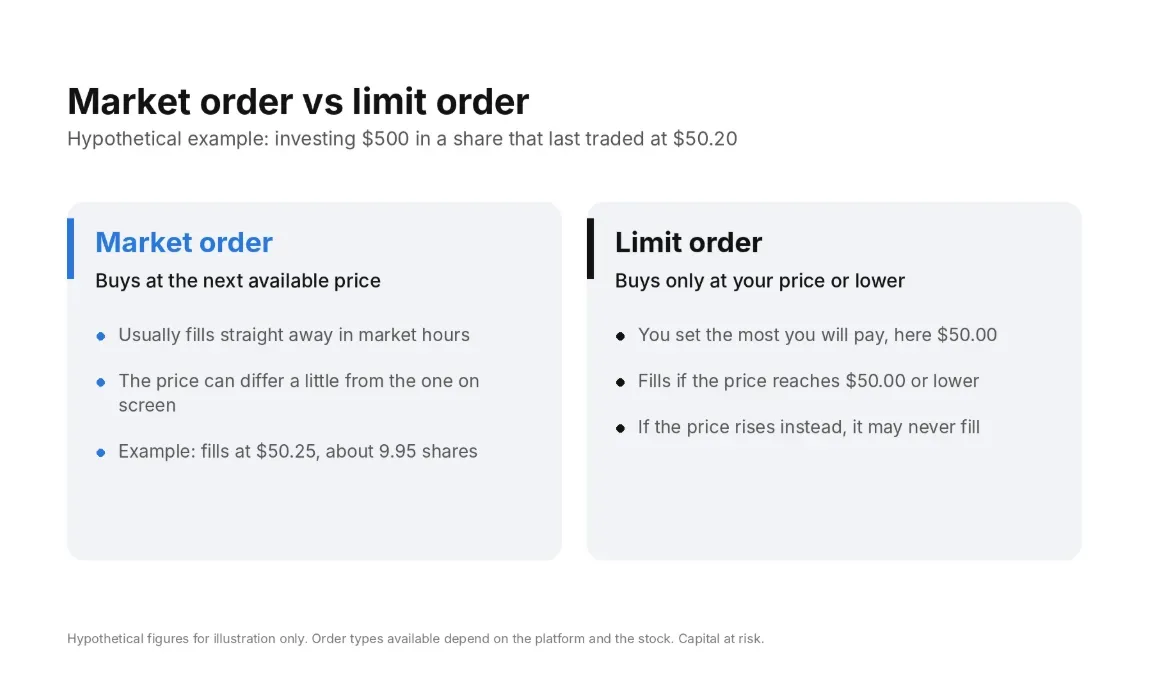
Hypothetical figures for illustration only. Order types available depend on the platform and the stock. Source: CUSP Wealth. Capital at risk.
Fractional orders may support only some order types.
When to place your order
The regular US session runs from 5:30pm to midnight UAE time from mid-March to early November, and from 6:30pm to 1am for the rest of the year. Our guide on what time the US stock market opens in the UAE has the full timetable.
Before you confirm, check the amount, the order type and the estimated fees.
Prices can move between the moment you place an order and the moment it fills. Capital at risk. The value of investments can fall as well as rise, and you may get back less than you invest.
Step 6: Manage risk: diversification, position size, long-term view
After your first purchase, a few steady habits do most of the work of keeping risk under control.
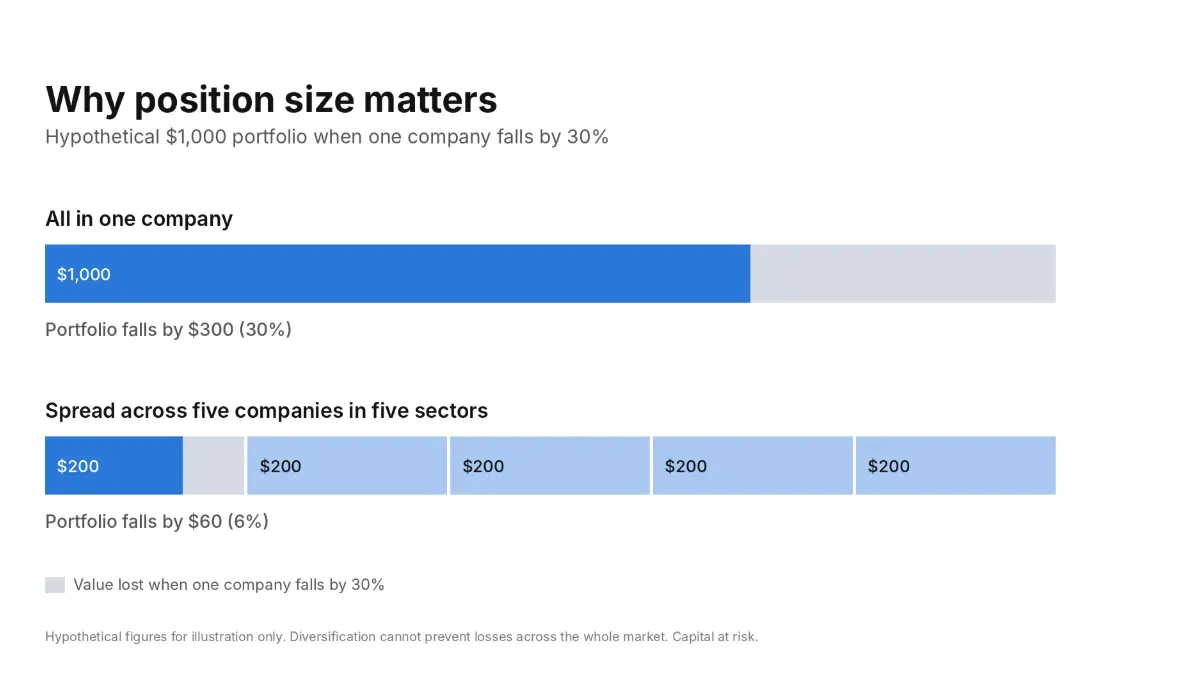
Hypothetical figures for illustration only. Diversification cannot prevent losses across the whole market. Source: CUSP Wealth. Capital at risk.
Diversify
Diversification means spreading your money across companies, sectors and, over time, different types of investment. It limits the damage any single company can do to your portfolio. It cannot protect you from a fall across the whole market. Our guide to portfolio diversification in the UAE goes into more detail.
Keep positions in proportion
A share that rises can grow into a large part of your portfolio. Once or twice a year, check whether any stock has grown beyond the share you are comfortable with. If it has, you can rebalance by trimming it or adding new money to your other holdings.
Take the long view
Stock markets go through falls, some steep and some lasting years. Selling during a fall turns a paper loss into a real one and can mean missing any recovery that follows.
Investing a fixed amount every month, sometimes called dollar-cost averaging, spreads your purchases over time so you are not relying on a single entry price. It cannot promise a profit or prevent losses.
Beginner mistakes to avoid
Investing money you will need soon. Money for the next few years is usually better kept in savings.
Putting everything into one company. Even well-known businesses can lose a large part of their value.
Acting on tips from social media or group chats. Do your own research, and be wary of anyone who promises quick or certain returns. That promise is a common sign of a scam.
Trading too often. Reacting to every headline tends to mean buying after rises and selling after falls.
Selling in a panic. Falls are a normal part of investing. Go back to your goal and time horizon before you act.
Overlooking fees and currency costs. Small charges add up over the years.
Borrowing to invest. Borrowed money and leveraged products can multiply losses as well as gains.
Skipping the licence check. Unlicensed firms and "investment" offers on messaging apps are a common route for fraud. The DFSA publishes alerts about firms that pretend to be regulated companies.
FAQ
How do I start investing in stocks in the UAE?
Choose a platform licensed by the DFSA, FSRA or CMA and open an account with your Emirates ID or passport. Sign a W-8BEN if you will buy US shares, add funds and place your first order.
How much money do I need to start?
There is no set amount you need. With fractional shares, you can invest a dollar amount instead of buying whole shares, so you can start with a sum you are comfortable with and add to it over time. Build your emergency fund first.
What is the difference between a market order and a limit order?
A market order buys at the next available price and usually fills straight away during market hours. A limit order buys only at the price you set or lower, so it gives you control over the price but may not fill.
Are stocks risky for beginners?
All stocks carry risk, and prices can fall as well as rise. Spreading your money across companies and sectors, keeping positions small and investing only money you will not need for years all help to manage it.
Can I buy US stocks with AED?
US stocks are priced in dollars, so your dirhams are converted before you buy, either by your bank or by the platform. The AED is pegged to the USD, but conversion fees may still apply.
Start investing with CUSP
Cusp Wealth Ltd is regulated by the Dubai Financial Services Authority (DFSA) and based in the Dubai International Financial Centre (DIFC). Investors use the platform to build and manage their own portfolios of US stocks. Fractional shares let you invest a set amount and spread it across companies in different sectors. $0 basic trading fees apply,¹ and all our charges are listed on our fees schedule. Learn more about CUSP.
Open an account and buy your first fractional share → Download the app
Capital at risk. The value of investments can fall as well as rise, and you may get back less than you invest.
¹ Basic trading fees refer to standard buy and sell orders in US stocks. Custody, currency conversion (FX) and other fees may apply. See our fees schedule for details.
Disclaimer: This article is published for educational and informational purposes only. It does not constitute financial, investment, tax or legal advice, and it is not a recommendation or endorsement of any particular financial product, fund or service. The value of investments can go down as well as up, and you may lose some or all of your capital. Past performance is not an indicator of future results. Readers should do their own research and consult a qualified financial advisor before making any investment decisions. Advisory calls are only available to clients who meet the suitability assessment required by Cusp Wealth. Not all financial products mentioned in this blog are products or services currently available from Cusp Wealth.
Any opinions, market commentary, research, analysis, prices, statistics, forecasts or other information referred to in this article are based on information available at the time of publication. Cusp Wealth Ltd takes reasonable care to ensure the information is accurate and drawn from sources believed to be reliable, but makes no representation or warranty as to its accuracy, completeness, reliability or continued applicability. Any third-party information used in this article is provided for information only. Cusp Wealth Ltd accepts no liability for any losses arising directly or indirectly from reliance on, or misuse of, the information in this article.
Cusp Wealth Ltd is regulated by the Dubai Financial Services Authority (DFSA) and is an entity in the Dubai International Financial Centre (DIFC). The firm holds a Category 4 licence (licence number 10863, reference number F011420) and is licensed to provide financial services to both professional and retail clients, including Shari'a-compliant products, in line with its DFSA licence and Islamic endorsement.
The information in this article is current as of October 2026 and is subject to change.